
Card Games Ezgas – Online Card Gaming Guide
Card Games Ezgas provides a comprehensive overview of online card gaming, where traditional card games combine with modern digital entertainment technology. From Texas Hold’em Poker, baccarat, and blackjack to Vietnamese card games such as Tien Len and Mau Binh, each game features distinctive dealing procedures, winning conditions, and payout mechanisms. Understanding Poker Hand Rankings, winning probabilities, betting odds, and bankroll management principles helps participants evaluate different gaming formats more objectively. These concepts also highlight the importance of recognizing financial risks associated with online gambling.
Explore Online Card Games at Ezgas

The online card gaming industry includes various entertainment formats, ranging from competitive multiplayer games to casino products involving comparisons against the dealer. Card Games Ezgas examines poker, baccarat, blackjack, and traditional Vietnamese card games while explaining their fundamental rules and gameplay characteristics.
Texas Hold’em Poker and Essential Betting Rounds
Texas Hold’em uses a standard 52-card deck. Each participant receives two private cards and combines them with five community cards to create the strongest possible five-card poker hand.
A standard poker hand includes four betting rounds: Pre-Flop, Flop, Turn, and River. Participants may choose Fold, Check, Call, Raise, or All-in depending on the circumstances and available actions.
Poker Hand Rankings range from High Card, One Pair, Two Pair, Three of a Kind, Straight, and Flush to Full House, Four of a Kind, Straight Flush, and Royal Flush.
Beyond hand strength, table position, remaining chip stacks, and Pot Odds influence strategic decision-making. However, no poker strategy can guarantee victory in every hand.
Baccarat and Blackjack Scoring Mechanisms
Online baccarat features three primary betting selections: Banker, Player, and Tie. Results are determined by comparing two hands, with the objective of predicting which finishes closest to nine points.
Aces count as one point, cards numbered two through nine retain their face values, while tens and face cards count as zero. When the total exceeds nine, only the final digit determines the score.
Online blackjack follows a different scoring system. Players attempt to achieve a total closer to 21 than the dealer without exceeding that limit.
Available actions may include Hit, Stand, Double Down, and Split, depending on the table rules.
Within card games ezgas, understanding Baccarat Rules and Blackjack Strategy helps distinguish automatic drawing procedures from strategic decisions that influence gameplay.
Tien Len, Mau Binh, and Popular Vietnamese Card Games
Tien Len is a traditional Vietnamese card game played with a standard 52-card deck. The main objective is to discard all cards before competing players.
Participants take turns playing valid combinations, including single cards, pairs, three-of-a-kind, and consecutive sequences. The rules for beating previous combinations vary between Southern Tien Len and Northern Tien Len.
Mau Binh, also known as Chinese Poker, uses 13 cards arranged into three separate hands: two five-card hands and one three-card hand.
Under common rules, the back hand must be at least as strong as the middle hand, while the middle hand must be stronger than the front hand.
In Multiplayer Card Games, outcomes depend not only on the cards dealt but also on how participants arrange their hands and respond to opponents.
Card Games Ezgas Betting Rules and Payout Mechanisms
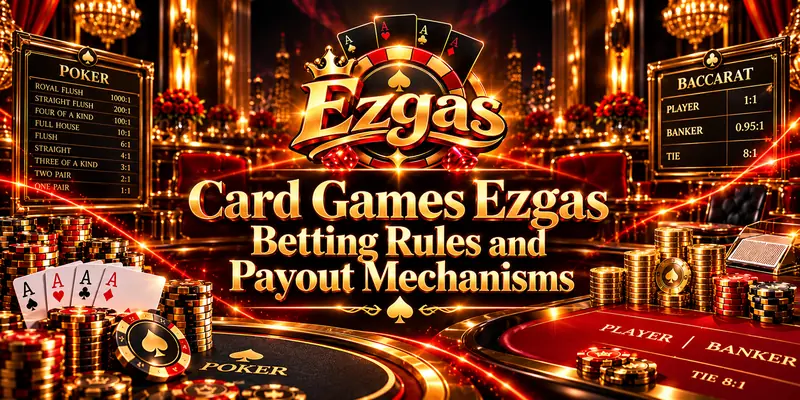
Online card games operate through dealing procedures, betting rounds, and settlement mechanisms. Card Games Ezgas examines these processes through RNG technology, mathematical probabilities, and payout structures to explain how different factors influence gaming outcomes.
Card Dealing Procedures and RNG Technology
Random Number Generator technology produces randomized outcomes used to simulate card shuffling and distribution in many digital card games.
A typical online card game follows four stages:
- Participants select a gaming table and confirm the required wager.
- The system shuffles and distributes cards according to established rules.
- Betting rounds, player actions, or hand comparisons take place.
- The system determines the final result and processes applicable payouts.
In properly designed RNG systems, card distribution is not influenced by the results of previous hands.
Live Dealer Card Games use human dealers and physical playing cards, while digital versions operate through automated algorithms.
Transparent dealing procedures and independent fairness testing are important considerations when evaluating gaming reliability.
Pot Odds, House Edge, and Payout Calculations
Pot Odds represent the relationship between the amount required to call and the total pot after making that call.
For example, suppose the current pot contains VND 300,000 and a participant must call another VND 100,000.
The calculation is:
Pot Odds = 100,000 / 400,000 × 100 = 25%
When analyzing card games ezgas, Pot Odds help poker players compare the cost of calling against their estimated probability of winning.
In baccarat and blackjack, the House Edge represents the casino’s theoretical mathematical advantage under specific gaming rules.
For example, a VND 100,000 wager with a total payout multiplier of 1.95 produces VND 195,000 when successful, including VND 95,000 in net profit.
Understanding the difference between Net Profit and Total Payout helps prevent confusion when interpreting payout tables.
Card Reading Strategies and Betting Round Management
In Texas Hold’em, Poker Position influences the amount of information available before a participant makes a decision.
Concepts such as Starting Hands, Bluffing, and Betting Patterns are commonly used to analyze opponents’ actions.
Pot Size, remaining chip stacks, and minimum betting requirements also influence decisions during individual betting rounds.
When researching card games ezgas, participants should distinguish probability-based decisions from emotionally driven actions.
A strong hand can still lose when an opponent holds a better combination. Similarly, a Bluffing Strategy may fail when another player decides to call.
Strategic knowledge can support informed decisions, but it cannot eliminate randomness or guarantee successful outcomes.
Card Games Ezgas Experience and Account Management
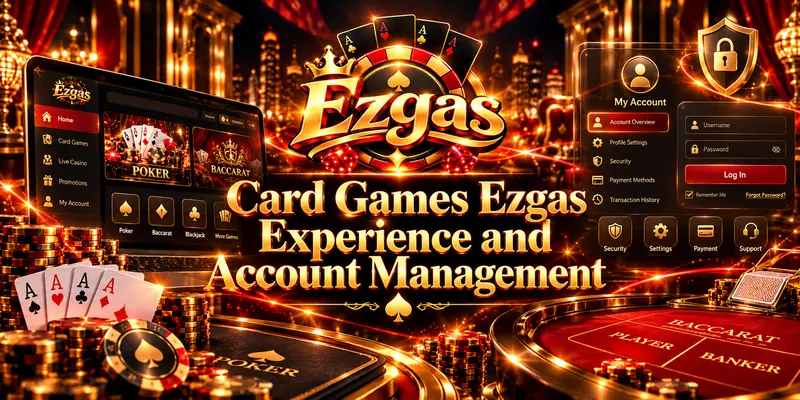
The quality of an online card gaming platform depends on interface accessibility, information security, and operational transparency. These elements provide important evaluation criteria when exploring card games ezgas and other digital gambling services.
Card Game Interface and Mobile Accessibility
A modern Poker Lobby should clearly display available tables, betting limits, participant numbers, and current room availability.
Controls such as Fold, Call, Raise, and All-in should be conveniently positioned, while action timers must remain accurate and easy to understand.
Responsive Design technology allows gaming interfaces to adapt across smartphones, tablets, and desktop computers.
For card games ezgas, fast response times, accurate information updates, and stable connections are important considerations.
Table filters can help participants find games according to player numbers, card game variations, and betting limits.
An intuitive interface should also provide convenient access to game rules, payout information, and transaction records.
Account Security and Transparent Gaming Results
TLS Encryption helps protect information transmitted between user devices and online servers. Two-Factor Authentication introduces an additional verification layer during account access.
A transparent platform should provide accessible hand histories, transaction records, account balances, and payment statuses.
When evaluating card games ezgas, participants should examine operating licenses, company identification, and independently verifiable RNG testing reports.
For multiplayer poker, Anti-Collusion systems help identify suspicious cooperation, fraudulent activities, or coordinated manipulation between accounts.
Know Your Customer (KYC) verification procedures, transaction limits, and privacy policies should also be clearly documented.
These measures contribute to account protection, game integrity, and responsible platform management.
Bankroll Management and Responsible Card Gaming
Bankroll Management helps participants control money allocated to gambling-related entertainment.
A spending budget should be established before each session, together with reasonable time limits and maximum acceptable losses based on personal financial circumstances.
When exploring card games ezgas, participants should recognize that poker involves strategic skills, but individual outcomes remain influenced by randomly distributed cards.
Increasing wagers to recover previous losses can create additional financial risks.
Card games should not be considered a dependable source of income.
Responsible Gambling tools such as Deposit Limits, Session Limits, and Self-Exclusion may help participants manage their gaming activity.
Users should also comply with applicable legal age restrictions and gambling regulations in their jurisdictions.
Conclusion
Card Games Ezgas provides a comprehensive overview of online card gaming, covering Texas Hold’em Poker, baccarat, blackjack, Tien Len, and Mau Binh. Understanding Poker Hand Rankings, Pot Odds, House Edge, RNG technology, and payout calculations helps participants evaluate different games more objectively. Beyond strategic considerations and entertainment, account security, transparent gaming results, and responsible bankroll management remain essential principles when exploring online gambling platforms.